x

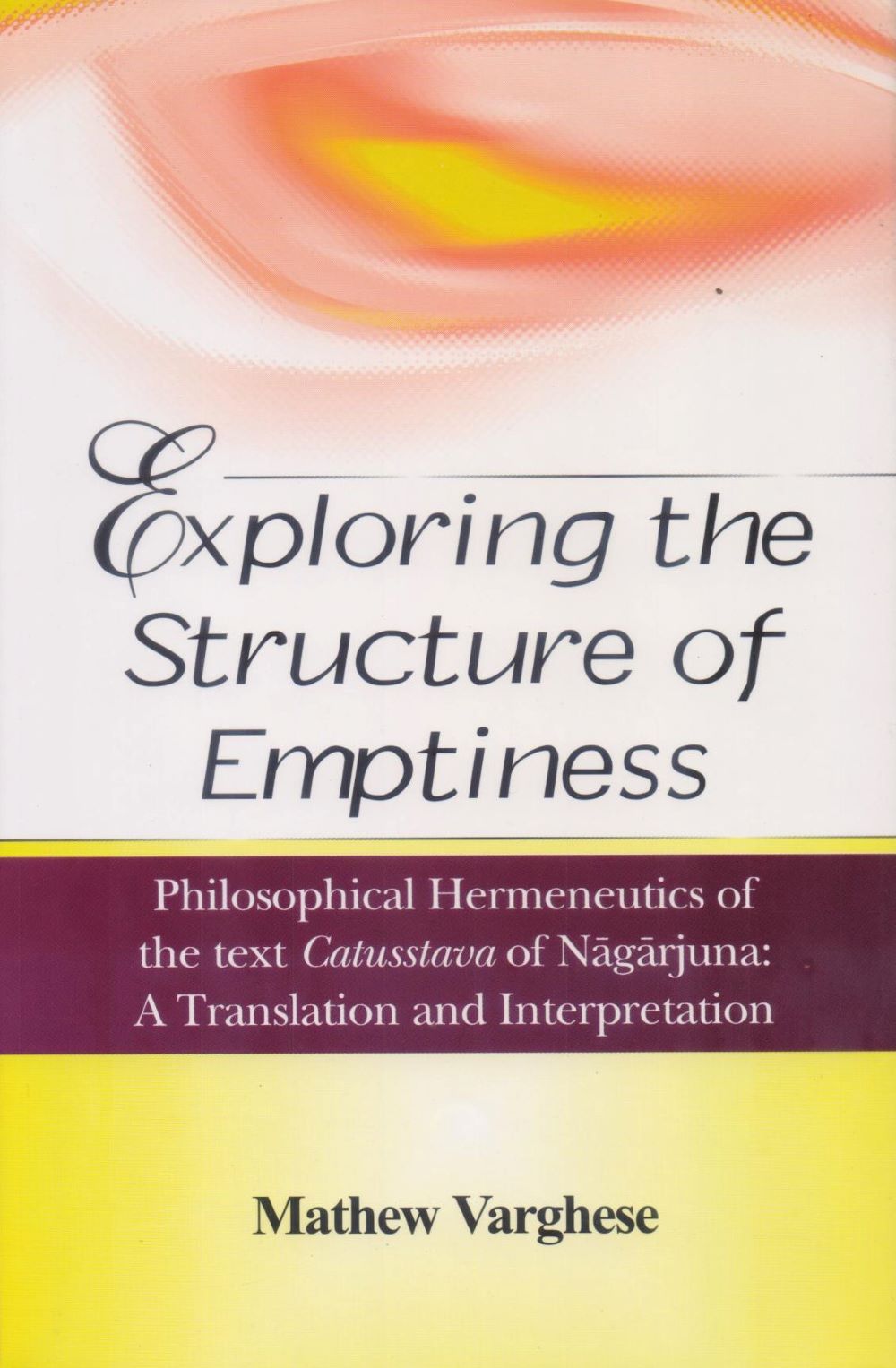
Front Cover

Back Cover

Exploring the Structure of Emptiness - Philosophical Hermeneutics of the text Catusstava of Nagarjuna: A Translation and Interpretation

Author:Mathew Varghese
ISBN:9788190995016
Binding:Hardcover
Year:2012
Pages:413
Size:15 x 23 x 3 cm
Weight:650 grams
Price:INR995896.00

About the Book
Nagarjuna is one of the finest philosophers who were ever lived. This second century Buddhist philosophers from south India is known for his criticism on speculative theories and viewpoints. But his name is better known for introducing the idea of emptiness (sunyata), a philosophical concept that had hugely influenced the discourses of Eastern philosophy, religion, and culture for about 2000 years. Nagarjuna cleverly introduced emptiness (sunyata), into Buddhist discourses to explain is central philosophy: the philosophy of Middle Path. Through the negative mode of argumentation, he taught how we naturally get trapped into extreme viewpoints and speculate on them. His philosophy of Middle Path (Madhyamika) explains the progress of human reasoning moving in its natural course avoiding extreme viewpoints for finding harmony and freedom. During the second century, in a different milieu, Nagarjuna warned his students about the dangers of speculative thought created out of extreme viewpoints and philosophical doctrines. He taught them to look into the structures of such doctrines critically by using negation to know what the truth is. Therefore, the philosophical idea of emptiness (sunyata) is not the end of negation assuming perfect nihilism, but teaching us that it would work like medicine for removing all our ignorance. More precisely, it is like zero (sunya) in mathematics, a number with an undefined value, but real numbers find newer values by associating with it. It is a philosophical tool that helps us control our alleged fears, anger, pretty hatred, etc., by invoking the natural course of human compassion (karuna) for us to live and die naturally. Therefore, the structure of emptiness is the philosophy of Middle Path.
About the Author
Mathew Varghese

Mathew Varghese is a scholar who works on classical philosophy, mainly, on the works of Nagarjuna, the second century Middle Path (Madhyamika) Buddhist philosopher. He shows keen interest in then discussing contemporary philosophical issues and interpreting them in classical philosophical framework. He has published two text-based interpretational works on Madhyamika philosophy: Principles of Buddhist Tantra (2008) and Exploring the Structure of Emptiness (2012); and also, several papers on Buddhist and comparative philosophy. He is a research fellow at The Nakamura Hajime Eastern Institute, Tokyo; and also teaches at Aoyama Gakuin University, Kanagawa University and Wako University, in and around Tokyo, offering courses on classical philosophy from a comparative perspective. As a researcher, he is keenly interested in researching the classical conception of Negation and its application possibilities.
Editorial Reviews


“In this superb book of transnational history, Richard Jaffe uncovers the role that South Asia played in the shaping of modern Japanese Buddhism. Using a wide array of primary sources, he brings to light the forgotten stories of those scholars and seekers who make arduous journeys across the oceans, seeking the traces of the Buddha in the land of his birth. Seeking Sakyamuni is a landmark work of scholarship: rigorously researched, sharply analyzed, and beautifully written. It richly illuminates the religious and intellectual history of Asia, the world’s most populous and most prosperous continent.”
—Ramachandra Guha, author of India After Gandhi
Seeking Sakyamuni will entice and reward readers working on many corners of the Buddhist world. Revealing a 19th- and 20th-century history of complex Buddhist, commercial, and political networks and entanglements within and beyond Asia, Jaffe teaches us much about the more recent history of Japanese Buddhism. Simultaneously, he reveals the central role of intra-Asian engagements in the creation of new modes of Buddhist organization and expression in Japan as well as India, Sri Lanka, Burma, and Thailand. Richard Jaffe’s longstanding interest in Buddhist objects and aesthetic forms greatly enriches this study, reminding scholars of modern Buddhism not to neglect the changing visual and spatial arguments that reflected and shaped Japanese Buddhist mobility in Asia.”
—Anne Blackburn, Cornell University
“Japanese Buddhism, like all religions, confronted a rapidly changing world in the nineteenth and early twentieth centuries, and had to remake itself in order to survive. The prevailing view has been that it did so by appropriating European models of religious learning and practice. Seeking Sakyamuni offers an important corrective to this view, demonstrating that South Asia—India, Sri Lanka, and Southeast Asia—loomed large in Japan’s new construction of Buddhism. Through thick description of Japanese scholarpriests residing long-term in South Asia, of wealthy Japanese tourists making “pilgrimages” to India’s Buddhist sites, of Japanese architectural innovations gesturing to Indian motifs, of South Asian monks participating in Japanese scholarly enterprises, and of much more, Jaffe shows that India left a visible imprint on Japan’s new Buddhism. This was not the result of a one-way transfer of religious culture in any particular direction. Rather, it was part of the creation of many modern Buddhisms out of cultural flows from East Asia, South Asia, and the West, which were ‘entangled, circulatory, and intercrossing.’”
—James Dobbins, Oberlin College
“An exceptionally well-researched and insightfully presented account of Japanese Buddhist travelers to South Asia during the late nineteenth and twentieth centuries, as well as the overall reception and impact of Indian Buddhism on the understanding and production of Japanese Buddhist temples, texts, and various aspects of intellectual and material culture in the modern period.”
—Steve Heine, Florida International University
“Richly documented, engagingly narrated, and methodologically innovative...”
Journal of the American Academy of Religion
“Searching implies looking for a thing knowing it exists and focussing on finding it out. However, the act of seeking seems to come with a deeper connotation of finding a new purpose, an enriched understanding, and a fulfilment of the seeker. Seeking Sakyamuni is a book of extensive and intensive research by Richard M. Jaffe in seeking the transnational history of the role of the Indian subcontinent in the formation of modern Japanese Buddhism in the nineteenth and early twentieth centuries. The book also works as a corrective to the prevailing notion that the rise of Indian Buddhist studies in Japan was the result of the importation of European and American scholarship in Japan. Contrarily, it was predominantly the outcome of the interpersonal, scholastic, spiritual, and artistic connection of Japanese Buddhism to South Asia through the educated clerics and laity who travelled to South Asia, mainly India, and brought back relics, images, artworks, and texts; thus bringing a new understanding of Buddhism.

As the book evidently presents to the readers, the contributors of this newer and deeper comprehension of Buddhism were vivid in their nature. Some of them were oriented in presenting the ritualistic mode rather than its rational face, while the others were contrarily trying to embrace the monastic, hierarchic brand. A third but smaller group was trying to discover the true practices as taught by the Buddha. Coming closer to the land of the origin on Buddhism, gave them new exposure to engage and educate themselves and carry forward their understanding and insight to Japan in the pursuit of modernisation of the ism.

This often appeared to be in sharp contrast with their understanding of Buddhism in the pre-modern period, when Japanese direct contact with India was extremely rare. The longing was intense, but the distance and difficulty of travel to India was overtasking. Remembrance of the Buddha (nenbutsu) was the way to meet him. Such a surrealistic connection gave rise to its own challenges. The findings of the pioneering travellers from Japan to India in the nineteenth and early twentieth centuries that have been meticulously researched and documented in this book often helped to clear the cobwebs of the previous understandings. The new understanding was based on the availability of information brought by these Japanese travellers from South Asia, heightened by new technologies like steamships, textile mills, mass printing, reinforced concrete construction, and photography. The evolving political and economic concerns also facilitated these pathways of closer ties between the two lands. This also gave rise to the pan-Asianist spirit in Japan, encouraging to build up a transnational solidarity with other Asians.

The readers will find in this book a historical canvas portraying the formation of modern Japanese Buddhism with shapes and colours from the Indian subcontinent, the land of its origin, giving rise to forms of mobility and exchange that transcend borders of nations and enchant the beholder with a thrill of experiencing the ever dynamic and subtle movement of man’s spirit of seeking.”

Prabuddha Bharata, September 2024: Vol. 129, No. 9
Customer Reviews
Stars
ADD REVIEW


Review Title

Review

Reviewer Name

Email


Sanctum Books
SANCTUM BOOKS
68 Medical Association Road
Darya Ganj
New Delhi-110002
INDIA


SOCIAL MEDIA

Facebook Instagram X


POWERED BY

Payment Gateway
Copyright © 2025 SANCTUM BOOKS. All rights reserved.
Website developed by WEBNET INTERNATIONAL